Cyberattack targets more than 30 Minnesota water systems
A coordinated cyberattack reached technology at more than 30 Minnesota water systems. We separate confirmed impact from speculation and outline OT/SCADA priorities.
- AUTHOR
- Karol Rapacz / CEO of Breachroad · OSCP · PNPT
- PUBLISHED
- 28 July 2026
- READING TIME
- 12 min read
- TOPIC
- Threats and Incidents
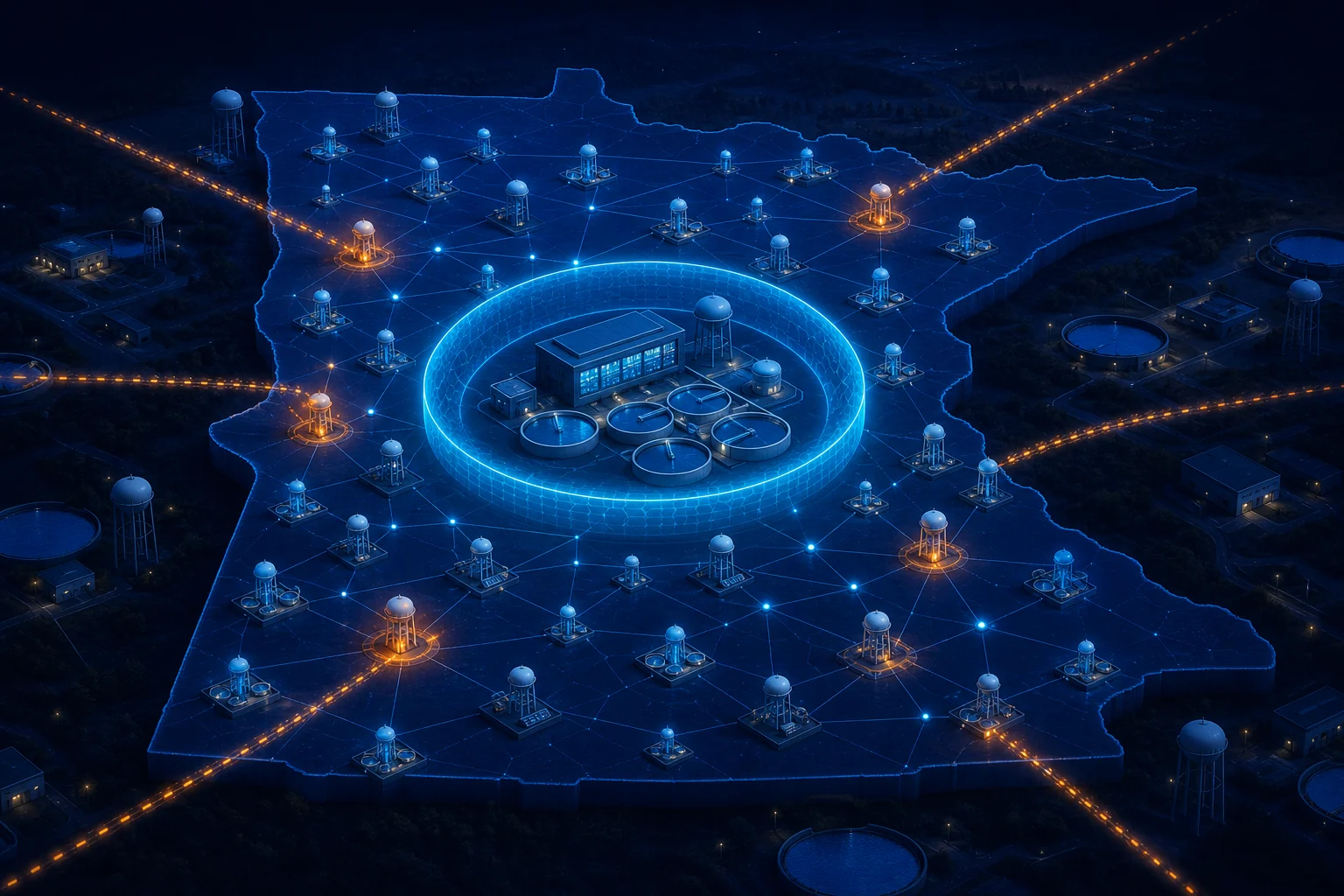
Minnesota officials reported on 28 July that a coordinated cyberattack targeted technology used by more than 30 community water systems. The activity ran from Sunday 26 July into Monday 27 July. The state activated incident response capabilities while affected organisations contained or mitigated the disruption.
The most important fact for residents is that, based on information available at publication time, officials found no threat to water quality or safety, and normal water use was permitted. That does not make the incident trivial. It shows the difference between an attack on operational technology and a confirmed process change or contamination—concepts that must not be conflated without evidence.
What has been confirmed
Minnesota IT Services (MNIT) told media that the coordinated activity affected technology used by more than 30 community water systems. Publicly named communities include Plymouth, South St. Paul, Maple Plain and Braham. State and local officials stressed that impacts were limited or mitigated quickly.
In Braham, the incident resulted in the well and treatment facility being offline for roughly two hours. The city said there was no physical problem and no effect on water quality. The system returned to service and operators continued normal delivery.
That is where the firm, publicly confirmed technical detail currently ends. At publication time, officials had not disclosed:
- the person, group or state responsible;
- the vulnerability or method used to gain access;
- whether the same mechanism appeared in every community;
- the complete scope of access across IT and OT;
- evidence of changes to treatment-process parameters.
That gap is normal in the first days of an investigation. Organisations preserve logs, compare configurations and determine whether observed failures share one origin. Professional analysis should not fill the space with speculation.
A cyber incident does not automatically mean contamination
A water system has several layers. The business network supports email, documents and billing. OT/SCADA supervises pumps, tank levels, pressure and parts of the treatment process. Independent laboratory measurements, process sensors and operator procedures help establish water quality.
An attack can therefore interrupt operator visibility, remote control or one station’s availability without changing the composition of delivered water. Even a short technology disruption still matters: pump and control availability affects service continuity, pressure and worker safety.
The right message is consequently “the incident is contained, water quality is being monitored and no hazard has been identified,” not “it was only an IT issue.” Independent confirmation of process safety is one of the central principles of critical-infrastructure response.
Why many small utilities are difficult to defend
Community water systems often rely on similar integrators, devices, remote-access services and configuration patterns. This simplifies maintenance but can create a shared risk concentration. One widely deployed technology or compromised service account may provide a path into several operators.
Small utilities also have constrained teams. The same person may own the physical process, plant maintenance and vendor coordination. A 24/7 SOC, full industrial-protocol monitoring and a dedicated response team may be outside the budget. Controls must therefore be easy to operate and remain effective without a specialist permanently on site.
The Minnesota Department of Health operates an annual OT/SCADA cybersecurity assessment programme for public water systems. The assessment requirement introduced in 2024 gives the state a common view of risk, but an audit does not replace remediation or response exercises.
OT/SCADA defence priorities
1. Inventory every remote connection
An operator should know who can reach an HMI, engineering workstation, SCADA server or vendor panel and why. Remove unused accounts and devices, eliminate direct Internet exposure for control services and route service access through a controlled jump host with MFA.
Shared technical accounts spanning several facilities are especially dangerous. We covered the same pattern in the cyberattack on a Polish water utility: one credential can have a blast radius far beyond a single site.
2. Segment IT from OT
A firewall between the business and control environments should allow only required directions, ports and hosts. Traffic must not flow freely from an office computer to a PLC. OT administration needs dedicated accounts, workstations and an access path, with every exception assigned an owner and review date.
Segmentation is not one appliance. It also covers backup separation, identity services and remote management. If ransomware in the office domain can delete the HMI configuration backup, the boundary exists only on a diagram.
3. Back up configurations and maintain a safe manual mode
Keep verified copies of PLC, HMI, historian, network-device and process-recipe configurations. Operators need to know how to move safely to local or manual control and which process limits apply when telemetry is unavailable.
The fallback needs to be exercised. A procedure in a binder does not prove that valves, pumps and sensors will behave as expected after months of change.
4. Monitor the process, not only logins
In IT, an unusual sign-in may be a sufficient alert. OT requires identity to be combined with process behaviour:
- controller logic or parameter changes outside a maintenance window;
- a new connection to an engineering workstation;
- commands from a host that previously only read data;
- loss of communication with several sites in a short period;
- simultaneous remote-access configuration changes;
- disagreement between an HMI value and an independent measurement.
Logs should leave the device they describe. If an attacker can disable an HMI and delete its only journal, the investigation begins with guesswork.
5. Respond with the process operator
Disconnecting an OT device “for safety” can itself interrupt service. Any isolation, restart or configuration-restoration decision needs input from someone who understands the physical process. The priorities are human safety, water quality, process stability, preservation of evidence and only then the speed of system recovery.
The first hour of a water-sector incident
When a utility sees simultaneous control failures or suspicious sign-ins, it should:
- confirm process state through independent methods and contact field operators;
- constrain remote access without making an unsafe change to plant operation;
- preserve edge-device, VPN, identity, HMI and engineering-workstation logs;
- notify the appropriate authorities and response partners;
- build one timeline spanning IT, OT and physical events;
- tell residents only confirmed facts about service and water quality.
Restoration should use clean, verified configurations, proceed in stages and include monitoring. Re-enabling remote access “so the vendor can help faster” without rotating accounts may restore the attacker’s access too.
Frequently asked questions
Was Minnesota’s water contaminated?
There is no evidence of contamination. Officials said they found no impact on water quality or safety and allowed normal use.
Who carried out the attack?
No perpetrator had been publicly identified at publication time. Attributing the incident to a group or state would be speculation.
Were PLCs compromised?
Officials have not disclosed that level of detail. We know technology at the water systems was targeted and the Braham facility was briefly offline. The scope of access to the control layer remains under investigation.
What is the highest-value control for a small operator?
There is no single answer. Removing direct Internet exposure, using individual accounts with MFA, controlling vendor access, segmentation, configuration backups and an exercised manual mode provide the strongest near-term combination.
Conclusion
Minnesota avoided any confirmed impact on water safety, but the scale of coordinated activity is a warning for critical-infrastructure operators. Resilience is not only about blocking entry. It is also the ability to operate locally, confirm quality independently, shut down shared access quickly and rebuild control from trusted configurations. BreachRoad helps organisations examine those dependencies through security assessments and testing.
Sources: FOX 9 — more than 30 water systems targeted in a coordinated attack, City of Braham update, MPR News on the Braham incident, Minnesota Department of Health OT/SCADA cybersecurity assessments.